Business Idea Bank Planning & everyday tools
Somewhere to put the idea before it disappears.
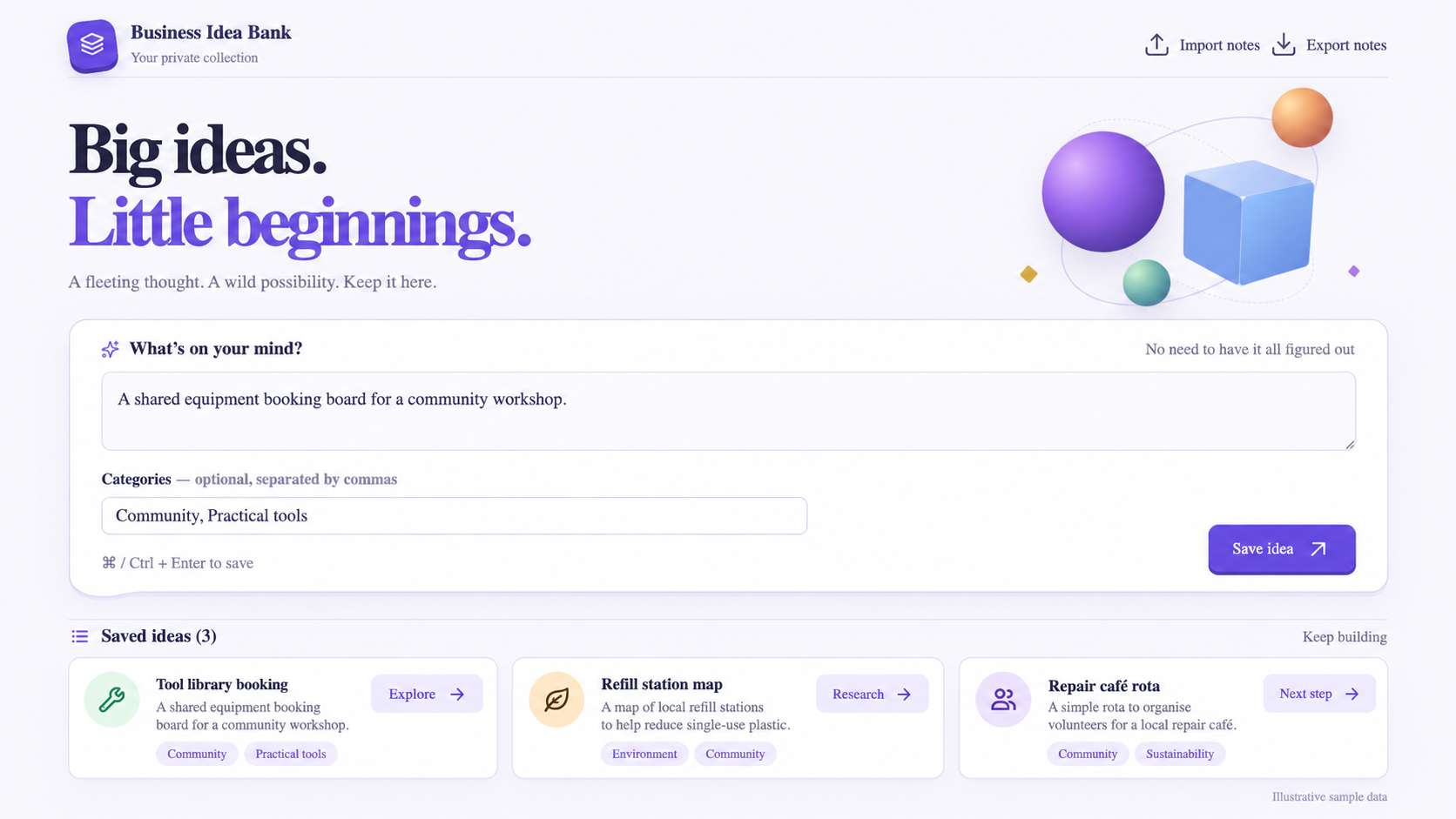
Quick capture first, then optional categories, source notes and more careful business research.
Project statusPrivate site
How it came about
I wanted somewhere I could just put ideas down. Not a form that expected a complete business plan, and not another filing system I had to organise before using it. The first job was to catch the thought while it was there.
Business Idea Bank gives those notes a colourful, more playful home. Capture is the starting point. Categories, follow-up notes and research can be added later, when an idea deserves more attention.
The difficult part
Bringing earlier notes into the site made provenance important. A source note and a later assessment are different things. I need to be able to correct or develop the assessment without losing where the original thought came from.
Comparing ideas introduces another risk: assumptions can look authoritative once they are displayed in a table. The site separates written research from original notes and keeps financial scenarios editable. A market-size estimate or an expected-value calculation is still an assumption-led model until there is evidence of demand.
What I learnt
I have learnt to give an idea room to be incomplete. Optional categorisation removes friction at capture; a separate research stage creates room for tougher questions afterwards.
I also want the research stage to ask harder questions than the capture stage. What problem would this solve? What would someone pay for? Which assumption would be worth testing first? Keeping that work separate lets an idea start as a rough note without treating it as a finished proposition.