Investing & Value Brain Research & systems
Research that keeps its working.
An investing dashboard and private site built around sources, appraisal history and challenges to the conclusion.
Project statusPrivate research system
How it came about
I wanted investment research to be easier to revisit and harder to rewrite in hindsight. A conclusion is much more useful when I can see the evidence behind it, the uncertainties at the time and the questions that were still open.
The Investing dashboard and Value Brain work bring together company research, evidence collection and an appraisal archive. A private site provides another way to organise that work. The aim is to make the research easier to repeat and inspect, with clear checks before relying on a conclusion.
The difficult part
The difficult part is preserving the distinction between new evidence and a changed opinion. If an old appraisal is silently replaced, the system loses its memory. It becomes impossible to assess what the original reasoning got right or wrong.
Automation also makes it easy to confuse volume with progress. More reports do not necessarily mean better research. I have put attention into source provenance, quality checks, preserved historical records and explicit points where a conclusion needs more work. The system has to be able to leave a question unresolved.
What I built
My contribution has been to build the research workflow around a question I want to be able to answer later: what did I know when I reached this conclusion? That means keeping the original assessment, the evidence it relied on and the unresolved questions together, then recording later changes separately.
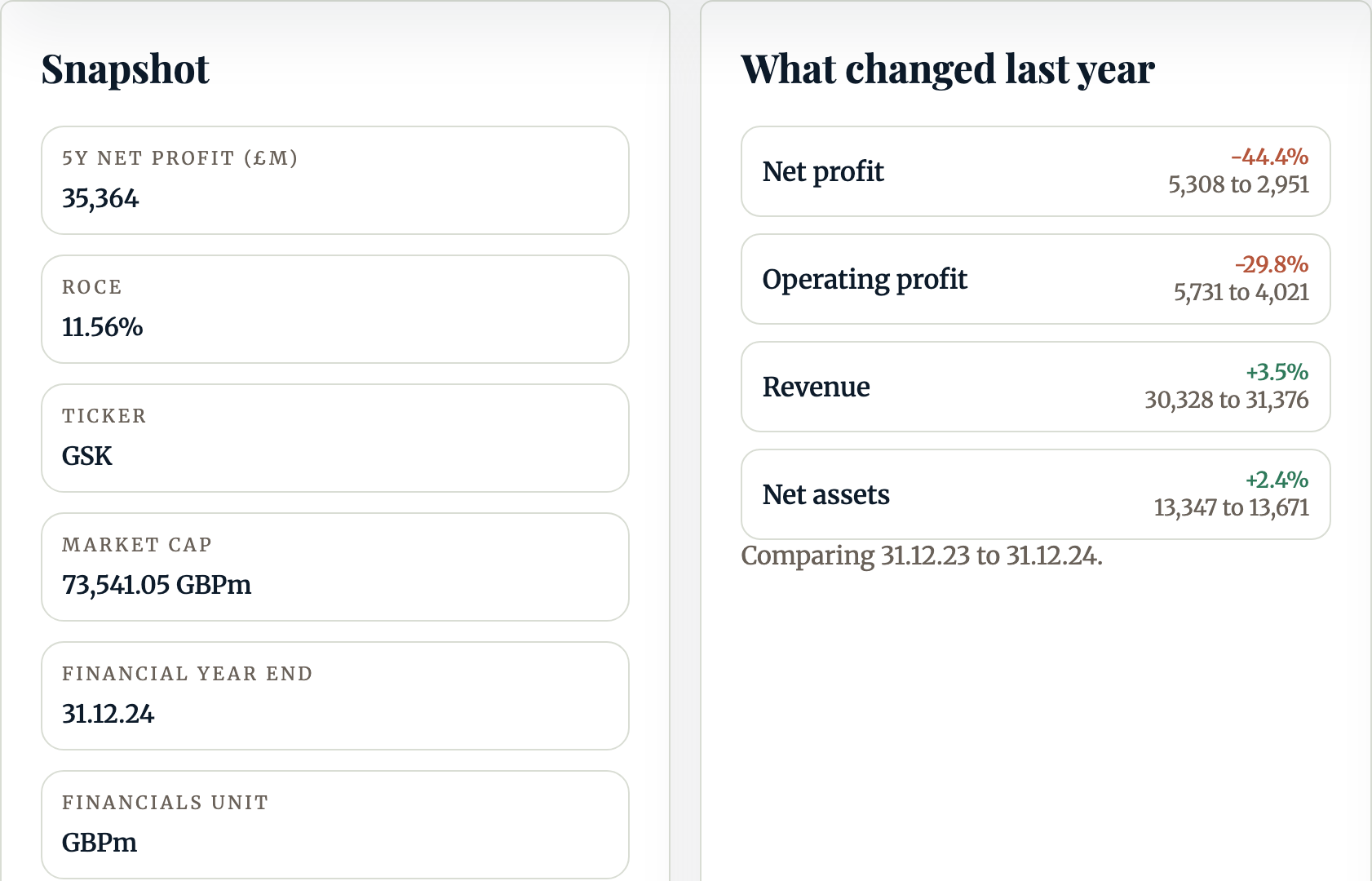
The work includes a dashboard, an appraisal archive and checks around accepting and preserving research. The screen above comes from my Flask dashboard and shows recorded GSK financial figures, including five-year profit and changes in revenue. These are the figures held in the system, with their financial year shown. The underlying research system remains private.
When the evidence changes
Consider a fictional research note which says a business depends heavily on one customer. The note should point to the report and passage that support that statement, record when it was checked, and distinguish the reported fact from my interpretation of the risk.
If a later report describes a different customer mix, I want a new assessment beside the earlier one. Quietly editing the old conclusion would make the history look more accurate than it was. If the supporting file is missing, that is an evidence problem to resolve, rather than an invitation to fill the gap with confident prose.
What I checked
On 13 September 2026, four focused archive tests passed using generated test records in temporary folders. They checked that a completed assessment creates an archive package; that repeating the operation leaves the history intact without creating a duplicate; that the package retains its source material; and that missing source material prevents a valid archive report.
This is evidence about the archive workflow in those test cases. It does not establish that the underlying research is correct, that every live appraisal has passed review, or that the system produces better investment returns. An orderly archive is useful because it makes those harder questions possible to examine.
Where it stands
This is a private research system that I am continuing to develop and scrutinise. The practical result I can demonstrate here is a tested way of retaining the reasoning and evidence around an assessment. I am not offering access to the investing system or presenting it as a financial-advice service.
The wider lesson is relevant to other research work: make it possible to trace a conclusion, challenge it and see what changed. Better decisions still depend on the quality of the evidence and the judgement applied to it.
What I learnt
I have learnt to treat the history as part of the product. Keeping earlier assessments intact makes later comparison more honest and helps expose repeated weaknesses in the process.
The lesson for me is to make it easy to ask why I reached a conclusion, and what would change my mind. That is the part of the system I want to keep developing. A more organised research process still has to earn its conclusions; the dashboard alone cannot tell me whether an investment decision will be a good one.