Access-air-bility® Aviation & accessibility
Making the passenger experience harder to overlook.
A passenger-centred website and research system for understanding where accessible air travel breaks down.
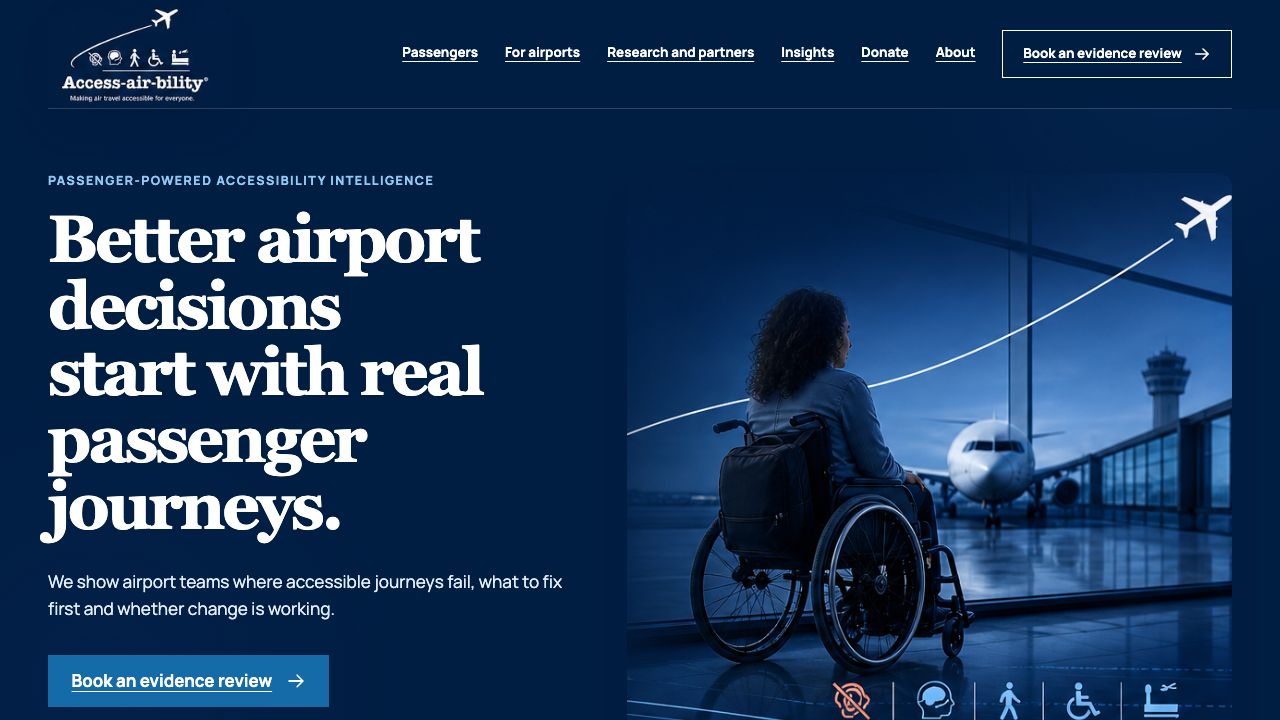
Project statusPublic website; passenger research and airport evidence reviews
How it came about
Access-air-bility grew out of a question I wanted to explore through my work in aviation: how can the experience of disabled and neurodivergent passengers help airports and airlines make better decisions?
I wanted to bring passenger accounts, research and practical information into the same conversation. The work has grown from a public website into surveys, a dashboard and an accessibility evidence system. Those are different parts of one project, rather than separate answers to the problem.
The difficult part
Collecting information is only the beginning. A published airline policy, a passenger account and an independent finding tell us different things. Putting them in a single table does not make them equivalent. The source, date and limits of each claim need to travel with it.
There is a similar challenge in the interface. A project about accessibility needs to be usable itself: clear language, readable pages and routes through the content that do not depend on someone already understanding the organisation of the research. The website and the evidence process both have to earn trust.
What I built
I have been developing Access-air-bility around two different needs. Passengers need somewhere to explain what happened during a journey. Airport teams need a way to understand what that experience reveals and what they might usefully change. The website gives each audience a separate route.
My work connects the public website, the passenger research route and the supporting research system. It also sets out an airport evidence-review offer. Having an offer on the site is not evidence that an airport has bought it or that a passenger outcome has improved; those would need separate proof.
Following one journey
Imagine a passenger who requested assistance but found that the handover between two parts of an airport was unclear. That is a fictional example, not a submitted account. Useful research would need to establish where the handover happened, what was requested, what actually happened and what remains uncertain.
A general score would lose much of that detail. I want the account to help someone ask a practical question about the service. It should also remain clear that one passenger’s experience describes that journey; it cannot, on its own, establish what happens to every passenger at an airport.
What I checked
On 13 September 2026, I reviewed the public routes for passengers and airport teams, including the survey portal and the explanation of the airport evidence review. The public site sets out its approach to consent, withdrawal and handling identifiable information. I did not submit a passenger account as part of this review.
Six focused automated tests for the research source manifest passed on the same date. They cover researcher access, supported requests and how source references are represented. These are checks on the supporting software; they are not an independent assessment of the service’s accessibility or of the quality of every source.
Where it stands
The public website and research routes are available, and the airport review offer is described there. The result I can show is a clearer route from a passenger’s experience to a question an airport team can investigate. I do not yet present independently measured changes in passenger outcomes in this case study.
That is the evidence I want the work to earn: whether the findings lead to a change, whether passengers notice the difference, and whether that difference lasts. Until then, the website and research process are part of the work, rather than proof that the problem has been solved.
What I learnt
I have learnt to be much more careful about the distance between a stated policy and a demonstrated passenger outcome. A good-looking benchmark can hide weak or uneven evidence if that distinction disappears.
That has made the questions I ask more specific. Where did the journey become difficult? What supports that account? Who could do something about it? I want the research to stay close to those practical questions, so that the passenger experience remains central as the project develops.